
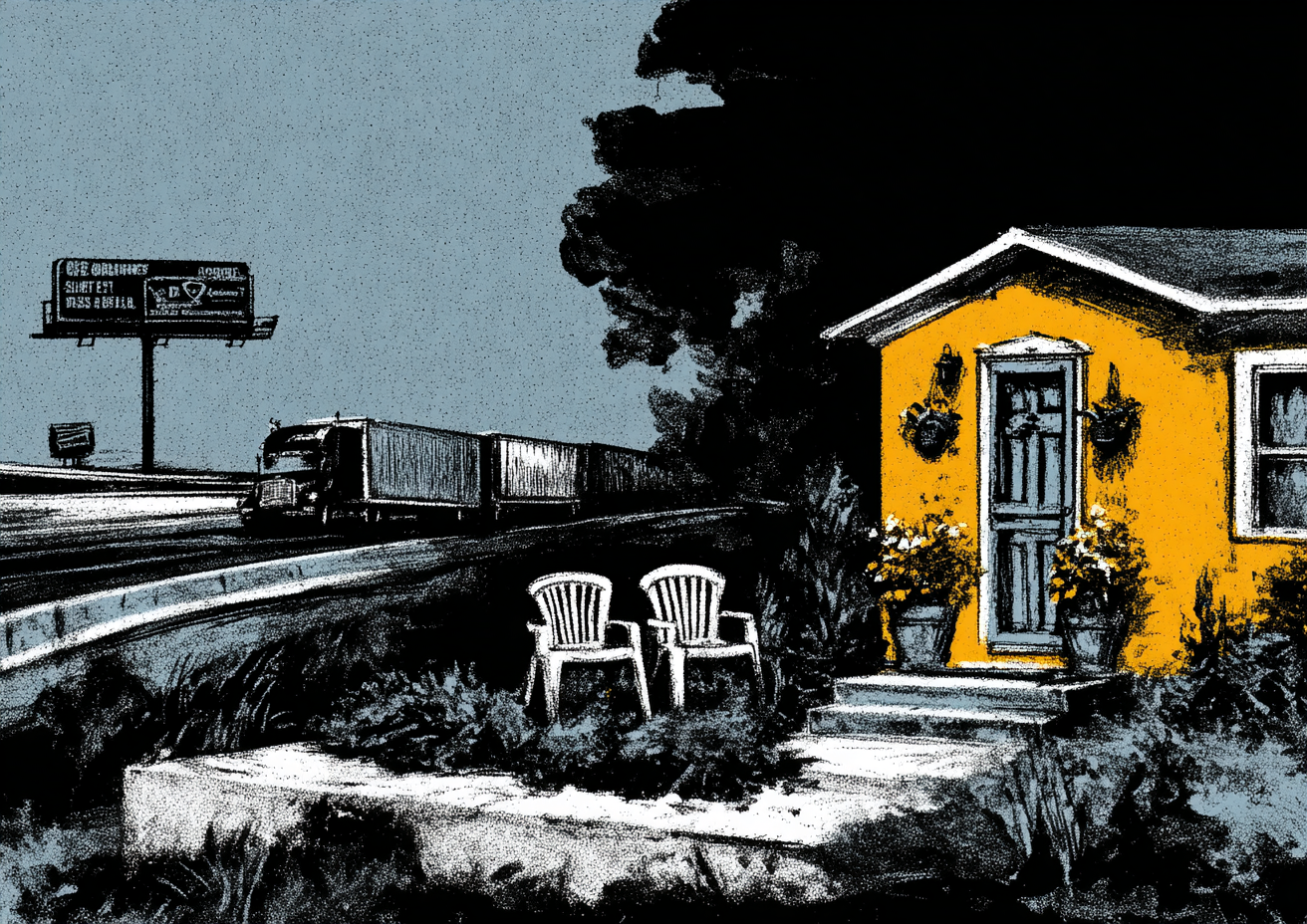
Little House on the Freeway
The second installment in Tales from the West Sider
I always look for it, no matter the weather or time of day. Cruising down the freeway, due West, I could be headed to Memphis if I had a mind, but instead I’ll be taking the next exit and driving the eight blocks home. Just as I glide into the far-right lane, I see it, The Little House on the Freeway, hunkered down in the shadow of the Cracker Barrel billboard.
The faded yellow, one-story dwelling looks like the lovechild of a mobile home and a shanty, or like an old prom queen in an ill-fitting dress whose date fled a long time ago. It’s the last house to leave the party; the only remnant of a neighborhood that was whole and thriving once upon a time; before the freeway sliced it in two. Clinging to the hillside, just a few yards from I40, it sits placidly facing danger every minute of every day with nothing but a low, concrete wall and a haphazardly short chain-link fence standing between it and oncoming traffic.
No matter the holiday, the front door is appropriately decorated. Valentine’s Day welcomes a shiny, red, heart-shaped wreath while Christmas is a more traditional affair. For Memorial Day and July 4th, the occupants of the house hang a tiny American flag from the door as well as red, white and blue striped ribbons. And for Halloween, a plastic, lit-up Jack-O-Lantern grins fearlessly at the rush of oncoming traffic, as if daring just one car to jump the wall.
But the thing that astounds me even more than the fact that the Little House is still intact despite being one blown tire away from oblivion, is the omnipresent pair of white, plastic armchairs that frame the front door. Why are they there? Does anyone actually sit in them, on the tiny slab of a porch, on purpose, to gaze at the terrifying spectacle of eighteen wheelers and crazy cruisers speeding towards their heads? It’s definitely a question for the ages.
I’d been driving past the Little House for years when, one sunny autumn afternoon I saw a woman standing on the front porch cleaning the glass and metal storm door. I nearly crashed into the low concrete wall as I craned my neck to see her, my heart pounding in my ears. She’s real! I blurted like a birdwatcher spotting a rare species in the wild. It was thrilling! Why does she bother to do that when it will be filthy again in a matter of minutes? I wonder aloud. She really must love that house!
At night, the porch light glows confidently as if reflecting the love its owner obviously feels for the curious, tragi-comedy of a dwelling. But I can’t help thinking what life must be like on the other side of that perpetually decorated front door. The constant vibration and searing hum of unrelenting traffic is probably loud enough to rattle your teeth. And the entire place must shake like Magic Fingers on overdrive, leaving you forever trapped on top of a 1960’s motel bed. At least you’d get the effect without having to put quarters in a slot. But is this really a plus? I wonder if the folks that live in the House That Never Sleeps have found a way to block it all out; the noise, the tremors, the belching fog of carbon monoxide and the real possibility that at any moment a Semi Truck-gone-awry could wipe them off the map. I haven’t a clue but that doesn’t keep me from wondering. If nothing else, they’re a testament to the human race’s talent for making pâté out of mincemeat.
I often toy with the idea of going over there and parking my car in the driveway that sits beside the house. I’d walk to the front, step onto that tiny porch, turn and face the belching onslaught of West-bound traffic and try not to pee my pants. And if I succeeded in that feat, I would turn and knock on the front door, which, when not honoring a holiday, is festooned with bright, plastic flowers, and I’d introduce myself as a curious neighbor, who wonders aloud every day, “How long have you lived here and why do you stay? Tell me everything!”