
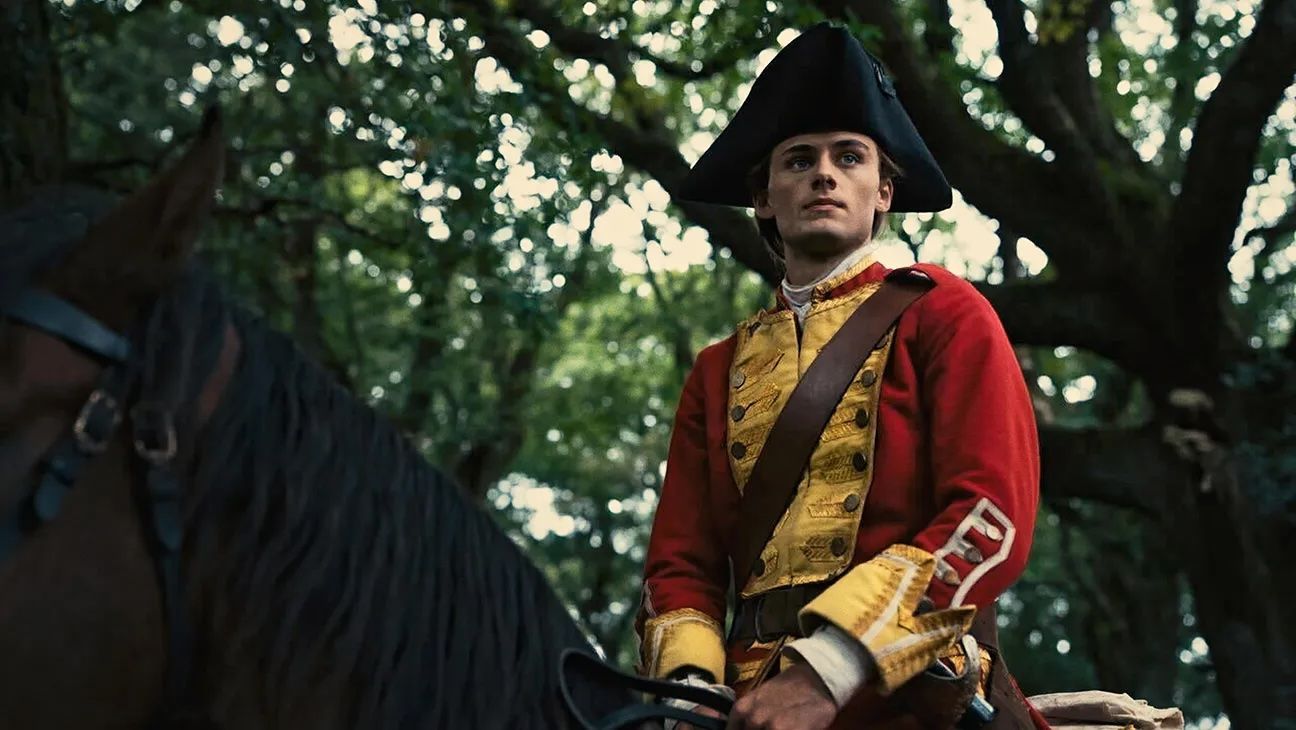
Young Washington in the New World
An Interview with Young Washington Screenwriter Tom Provost
Over the last decade, the Greater Metro Nashville Area became an unheralded major hub for feature filmmaking. Since the release of director Jon Erwin’s MercyMe biopic I Can Only Imagine in 2018, Franklin’s Kingdom Story Company has elevated the faith-based film market with a string of Erwin-directed hits, including Jesus Revolution and I Still Believe.
In the three years since the breakout success of human-trafficking drama Sound of Freedom, Utah-based Angel began expanding its footprint in the area, working with local filmmakers Steve Taylor and Seth Worley on the Nashville-shot family movie Sketch and tapping Nashville animators and postproduction supervisors on last Christmas’s hit biblical musical David.
Now, Franklin resident Erwin and screenwriters Tom Provost and Diederik Hoogstraten have teamed with Angel for the studio’s most ambitious film–an origin story of George Washington’s rise to prominence during the French and Indian War.
Young Washington hit theaters nationwide last week just in time for America’s 250th anniversary and could prove to be Angel’s biggest hit yet. Since its premiere last month at the Tribeca Film Festival, the film has garnered buzz and a series of strong reviews that have far outpaced its made-by-committee multiplex rivals like Supergirl and The Mandalorian and Grogu.
Starring relative newcomer William Franklyn-Miller as Washington and filled with a who’s-who of veteran British actors like Ben Kingsley and Andy Serkis at their preening Red Coat best, the film is a hard-hitting throwback to the long-gone days of the historical big screen epic, not since The Right Stuff has a movie so perfectly encapsulated the risk taking and individual drive that have defined the nation. All on a budget of less than $30 million.
While you won’t see Young Washington (or any of Angel or Kingdom’s efforts) on the screens of Music City cinema gatekeepers like the Belcourt and the Nashville Film Festival, the film represents a great leap forward for the city’s reputation as a community for quality filmmaking that defies Hollywood’s status quo in a similar way to Washington as he forged his own path.
On the eve of the film’s release, Provost spoke with The Pamphleteer about Washington’s legacy, biopic conventions, and what truly defines an American epic.
This interview has been edited for length and clarity.
Something I’ve been thinking about since Christopher Nolan’s trailer for The Odyssey came out is that America doesn’t really have an epic in the same way as the British or the Greeks or the Romans. Maybe that’s because the Hollywood movie now serves that purpose. Washington and the other Founding Fathers are the closest we have to this type of unifying myth. Why do you think there have been so few attempts to make a movie about this period?
Movies about the American Revolution have mostly tanked. The Patriot is a rare example of a movie that was popular about the Revolution, but you can look back, and a lot of movies about the War just didn’t do very well. It was hard to get studios behind it for some reason.
I’m very thankful that they waited. I keep saying [about Young Washington] it’s not a Titanic budgeted movie, but it’s a movie like Titanic or Gone With the Wind that is this epic, historical, adventurous look at this young man’s life.
Obviously, this movie is not about a musician, but it adopts the same strategy as a lot of the more successful recent music biopics like Michael and the Springsteen and Dylan movies that focus on a very well-known figure at a pivotal moment as opposed to the cradle-to-the-grave way we’ve been used to seeing these stories. What are some of the positives of that approach and what were some of the challenges that you faced?
When you look at biopics, the ones that go cradle-to-the-grave tend to be really boring and don’t have a focus. It seems that over the last 10 or 15 years, people have figured out they should focus on one period. I love the Steve Jobs movie, which focuses on three periods. This entire project is our director Jon Erwin’s vision. My writing partner, Diederik Hoogstraten, and I were brought on just to help him get it on the page. But he believed it was the right approach for a number of reasons. One is that it’s such an interesting part of Washington’s life because it teaches us how and why he became such a great man. You can look at Washington later in his life and try to emulate him being great, but how did he get there?
The movie shows how he became great, which is basically through failure and heartbreak. I do a lot of adaptations and they’re difficult because you have too much information. I was amazed when I was hired and I started looking at his life. The period from 18 to 22 years old made me think, “Oh my gosh, this is the movie.” We didn’t have to change very much. The movie is pretty historically accurate. We worked very hard for it to be as accurate as we could.
The difficulties are that it’s a big, bold, movie without a Hollywood budget. Jon and the production team have done an amazing job making it feel much bigger. As a friend of mine said, you get an amazing bang for your buck when you watch this film.
My favorite aspect of this particular movie is the way that the film presents history with a lot of nuance. We are in this social media age and have been for the last half-decade where a lot of people are trying to put forth a very narrow view of George Washington and his legacy. But, the underlying theme of this movie focuses on how everybody was colonized in so many different ways beyond just the Native Americans and the slave characters sent to the territory. The film makes no secret that Washington is never going to be part of the system that he wants to be a part of, and that’s what wills America into being. How did you approach the tensions between the reality of the time and the superficial way a lot of online activists have tried to retcon Washington’s reputation since 2020?
I would say we just strove to tell the story as accurately as possible as much as we could. You have to change certain things and you have to condense. Kelsey Grammer’s character combines two figures. Timelines were changed just a little bit. Washington met Sally after she was married.
It’s always difficult to write something like this, and that’s part of the fun. But it was not as difficult as other projects that I have done because Washington’s life was just a movie. As ambitious and egocentric and self-centered as he was when the movie starts, he ends up becoming this truly great man. It was very enjoyable to immerse myself in Washington for a time, because it made me grow as a person also.
There’s no shortage of books on George Washington. How did you go about the research process?
We just dove into the biographies. And I must say, Diederik went on a much deeper dive factually than I did. I had more of the fun. I went to Mount Vernon and just immersed myself in that world for a few days to get a feel for his world.. I am kind of the internet nerd who was just looking all around the web finding out interesting things about him.
My mother was a history professor, and her concentration was on the Revolution and the Civil War. She loved it. I never got to take her class, but she apparently was a pretty amazing professor. She tried to immerse me in it as a child, and I wanted nothing to do with it. All I wanted to talk about were movies and fiction books. I know it was frustrating for her at times, but this was a love we did not share.
My parents died very young, but my mother has to be laughing in heaven that all of a sudden, because of this job, I had to immerse myself in what she loved. And I did fall in love with it. That actually has been very moving for me to discover later in life what she was trying to teach me.
So it’s in your blood then to make this kind of project?
One of our family’s favorite movies was the very first Vacation with Chevy Chase and Beverly D’Angelo because every summer we would get in the station wagon and drive somewhere, and it was always this hell trip. If there were a little placecard, we had to stop and look at it. We went to Monticello, went to Mount Vernon, and we’re just like, “Oh, can we go to Disneyland?” and, “Why do we have to see all this stuff?”
But the method to my mom’s madness was that in junior high and high school, when I got to American history, I was like, “Oh, I’ve been to all these places.” It came to life much more than for my friends who had not been to those places. She was very smart.
This is a very Southern movie. What do you hope Southern audiences and those in Nashville in particular take away from the film?
We’re at a divided time. Historically, though, I don’t think it’s any different. There’s a wonderful book by William Safire called Scandalmonger, where he looks at elections and politics. It was just as vicious and brutal in Washington’s time as it is now. I’m not quite sure we should be as horrified as we are.
We found that Tribeca was a great example. You can have people on both sides of the aisle come to this movie and love it and enjoy it and feel good about the United States of America when it’s over. I do think when it opens over the 4th of July, Middle America and the South will make it explode–maybe not quite as much on either coast, but I think it’s going to get there.
It is a movie that can hopefully unify people by being able to look at our country in a different way. As Jon says, all he wants is for people to see the movie and get excited and just go home and actually start reading history books to find out in depth what happened when our country started–this grand experiment of the United States of America.
Young Washington is now playing in theaters.